2026 is going to be the year that development actually moves to the cloud.
Folks have been talking about this shift for a long time – after all, it’s pretty unusual to use an offline desktop app to do knowledge work these days and most other knowledge-work interfaces have moved from local, single-user desktop software to cloud-based collaboration. The transitions from Word to Google Docs or Sketch to Figma are good examples.
But up until now, there hasn’t been a great reason for software development to move off of the laptop and into the cloud. In fact, there were some good reasons it shouldn't. I wrote a blog about this a few years back. TL;DR: the pull to work in the cloud wasn’t that strong for developers, the setup costs were high, and the ergonomics were poor compared to local development.
This is all going to change this year, and not in the way anyone would have predicted a few years back. It’s all because of... you guessed it... agents.
The reasons are simple:
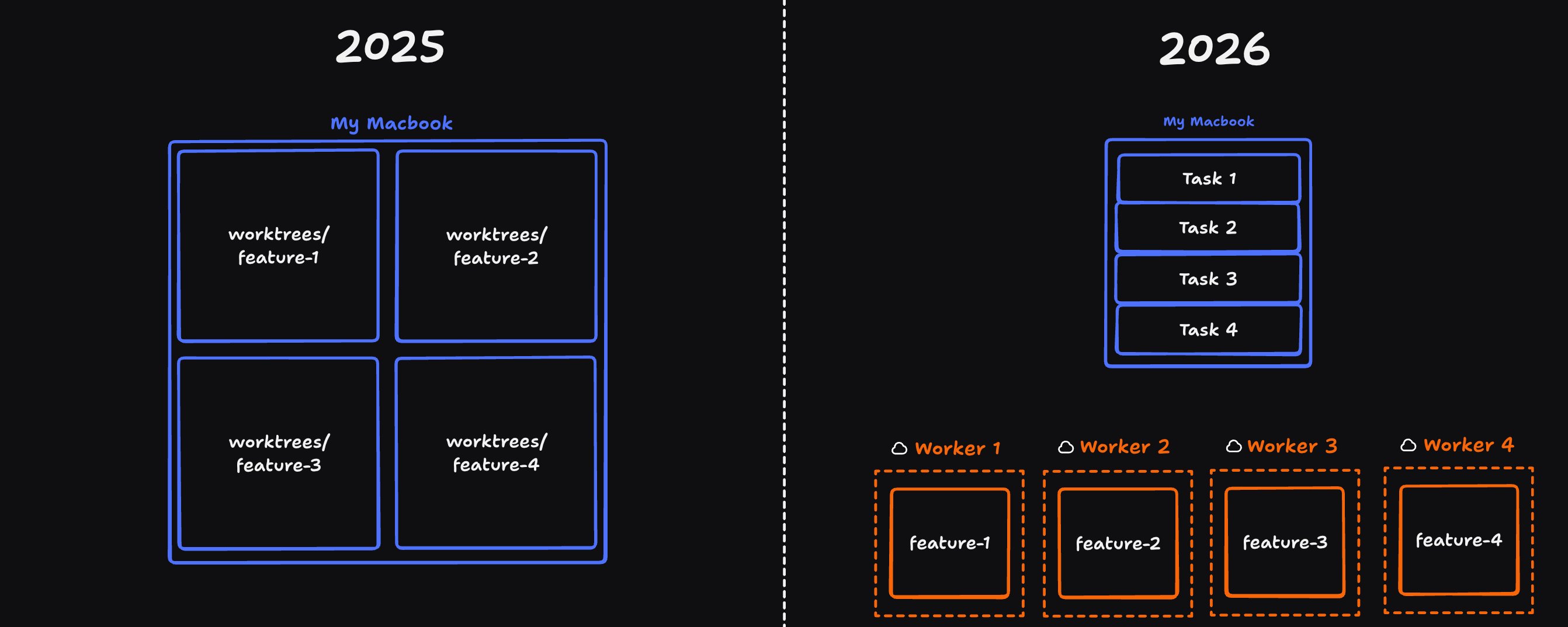
**We are running out of laptop capacity. **We maintain a large-scale Rust codebase for the @warpdotdev terminal app, and running even two cargo builds simultaneously will strain our SOTA Macbooks. Let alone 10 agents running in parallel.
**Agents cannot test their work simultaneously if they need computer access. **Say, to click around a native application using a mouse. This requires sandboxing to run agents in parallel.
Agents need to be working at all times, regardless of whether your computer is awake. They are increasingly running off of timers and system events and can’t be tied to laptop state. A Mac Mini in your closet isn't going to cut it.
**Companies want visibility and tracking of agents. **This points to less of a DIY workflow and more standardization of orchestration and tracking off of personal machines.
**And the big one: agents actually make it much easier to set up cloud environments! **This used to be a pain. Making Docker files, provisioning machines, etc. A lot of the tedious configuration can be handled by agents now.
I remember the first time I used a Google Sheet in 2006 where there were multiple collaborators moving around its cells in real-time. The experience was magical, and it was pretty obvious that it represented the future of how document collaboration would work. Everything would be shared via link, with one cloud-based source of truth that multiple people could work on together.
That moment wasn’t about spreadsheets. It was about where work happens.
I have a similar feeling today building agentic development tools at Warp as I did when building Google Sheets 20 years ago (I spent eight years working on Google Sheets). The center of gravity is shifting from individual machines to shared, orchestrated systems.
There’s still a bunch to figure out to make all of this work well for development, but Warp’s new product Oz is our first stab at solving the problem.
2025 was the year of interactive agents. 2026 will be the year of agent orchestration. Agents don’t belong on your laptop. They belong in the cloud.