Introducing Warp AI

Today I’m excited to share Warp AI, AI that's built into the terminal to make you more powerful as you work. Currently in beta and available for free preview, Warp AI is available to try today in the latest version of Warp.
Watch this demo video to see it in action:
The fastest way to become a terminal power user
The terminal is a powerful platform for all sorts of developer workflows – from building, running, and testing code, to interacting with your cloud or building internal tools. However, that power is hidden behind a notoriously difficult interface.
Traditionally, the way developers have mastered the tool is through some combination of Googling, Stack-Overflowing, and, in days past, leaning over the shoulders of other CLI experts, picking up their tips and tricks along the way. I remember this is how I learned sed – watching our tech lead instantly slice and dice user logs to find what I was looking for after I’d spent hours mucking around myself to no avail.
As of today, developers can master the terminal by asking Warp AI how to get stuff done.
AI as a core part of the terminal
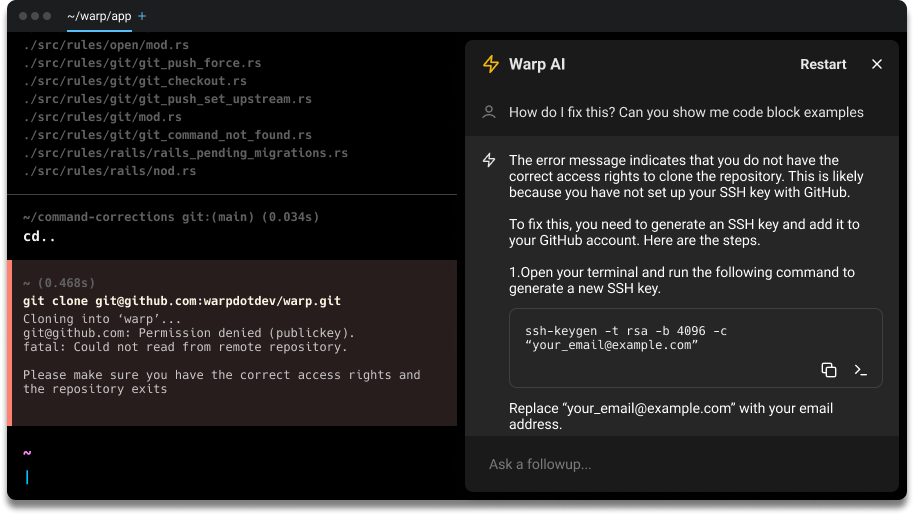
The key advantage of Warp AI is the way it interacts with terminal inputs and outputs. A typical loop starts with asking it to explain an error or suggest a fix from the command line. When you get a response from Warp AI, you can run that AI-generated command without copy/paste or context switching.
Ask Warp AI to write you a script to connect to a cloud instance and you can run it directly without leaving the terminal. Ask Warp AI to install the latest version of postgres and it will walk you through each step, one command at a time.
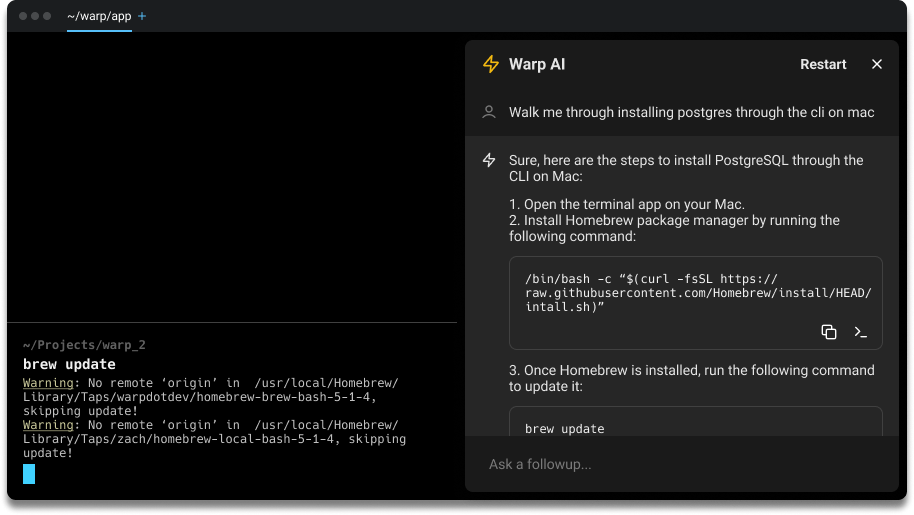
Because Warp groups outputs and inputs together as blocks, you can ask AI for help on a specific command's output. This is especially useful for errors, but it can also explain anything that a public terminal program is outputting that you don’t understand – git, I’m looking at you…
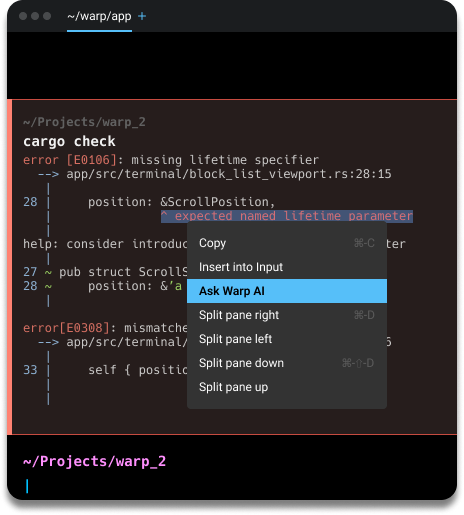
If you need to be more precise than a whole block, you can also feed any text selection directly into Warp AI.
Privacy and security
We realize that the terminal is a very sensitive environment and so we want to be explicit and transparent around what’s leaving your local machine when you use Warp AI.
Only what you explicitly enter into the Warp AI chat input ever leaves your computer. Since Warp AI is built on OpenAI, OpenAI’s servers will receive this input. We have not opted-in to allow OpenAI to train their models on this data.
Warp itself does not store any of this info and only passes it through our servers when we proxy requests to OpenAI.
What’s next?
While Warp AI is a powerful integration today, we can take it much further. We believe there are opportunities for AI to help both individuals and teams at work.
For example, one of the first things we plan to ship is a new AI command prediction feature using a local-first Bayesian model.
AI is so well suited to the terminal. It’s an extreme power tool whose limiting factor has always been that it’s hard to use well. It’s the perfect use case for a built-in AI assistant.
Available now in free preview
Warp AI is available today for all users as a free preview. You can make up to 100 requests per day during this preview period.
In the future, this feature will be part of a paid plan, but for now we want to let you experience its power while we continue to tweak and improve the integration.
Please check it out and let us know how it goes in our Discord and on Twitter.
Start your software factory
Book a demo and we’ll walk you through the workflows that map to your stack.
Related articles
Sep 18, 2026Product
7 min
Using LLM-as-a-judge scoring to measure your software factory
7 min
Sep 5, 2026Product
8 min
The Factory Stack
8 min
Sep 3, 2026Product
6 min
Introducing Factory Benchmarks
6 min
Aug 18, 2026Product
14 min
Introducing Warp Factories - open, flexible infrastructure for building your software factory
14 min
Aug 4, 2026Product
6 min
Introducing the Warp Agent CLI: a CLI coding agent that does what others can't
6 min
